Method
The Judgment Line
A method for deciding where AI belongs in a business process, and where it does not.
The two questions
Most AI projects start by asking can AI do this work? That is the easier question, and answering it alone is why so many pilots stall or embarrass the people who ran them.
There is a second question, and it is the one that decides whether a deployment survives contact with a real customer, a regulator or an auditor:
May the machine do this work alone?
Technology answers the first. Accountability answers the second. When an AI output goes wrong in public, the draft was usually fine. What was missing was a person who was supposed to look at it, and a clear statement that it was their job.
The judgment line is the boundary between work a machine may finish and work a person must finish. It moves by task, industry and regulation. It does not move because the model got better.
The method, in six steps
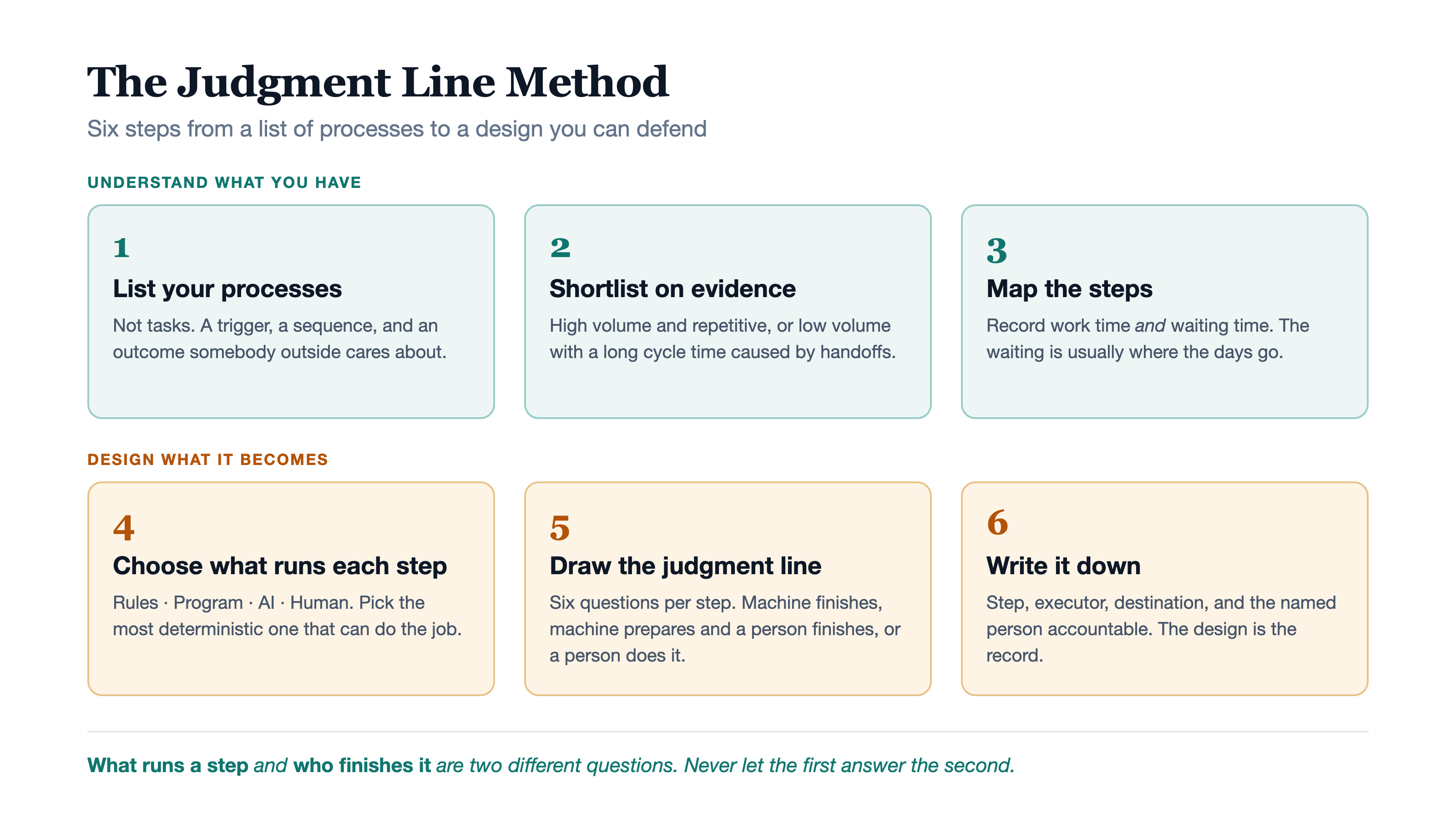
- 1List your processesNot tasks. A process has a trigger, a sequence, and an outcome somebody outside the process cares about. Vendor onboarding, invoice approval, claim intake, contract review, recruitment screening, month-end close. Start here rather than with a list of tasks, because tasks automated in isolation leave the process exactly as slow as it was.
- 2Shortlist on evidence, not enthusiasmTwo patterns qualify a process, and one of them gets overlooked almost every time. The first is high volume and repetition. The second is low volume with a long cycle time, where only a handful of instances a month each take days or weeks because the work passes through several people who each have a queue.
- 3Map the steps, and record the waitingFor each step write down what comes in, what is done, what goes out, who does it today, how long the work takes, and how long the step waits before it starts. Most process maps capture the first four and skip the last two. The last two are where the answer is.
- 4Choose what runs each stepFour executors, and each step gets exactly one. Choose the most deterministic executor that can do the job, because determinism costs nothing at run time, gives the same answer twice, and is what makes a process explainable afterwards.
- 5Draw the judgment lineSix questions, answered per step rather than per project, sending each step to one of three destinations. This is the part that decides not whether the machine can do the work, but whether it may do it alone.
- 6Write it down and keep the recordThe output is one table per process: step, executor, destination, and the named person accountable. That table is both the design and the governance artifact. It is what you show a client, an auditor or your own board when they ask how AI is used here and who is answerable for it.
The test that finds the second pattern
Compare touch time, the minutes of actual hands-on work, against elapsed time, the days from trigger to outcome.
A process that takes nine days end to end and forty minutes of hands-on work does not have a work problem. It has a waiting problem.
That distinction changes the answer completely. If the delay is waiting, then AI that halves the forty minutes saves nothing anyone can feel. What helps is removing handoffs, so that steps run when they are ready rather than when somebody gets to them. It is also why the highest-volume process is not always the one where automation returns the most, and why a low-volume process with six handoffs never surfaces if the shortlist is built on transaction counts.
Four things can execute a step
| Executor | Use it when | What you get |
|---|---|---|
| Rules | The logic is already written down and can be stated as conditions | Deterministic, instant, auditable, free to run |
| Program | The step is real computation over your own logic or calculations | Deterministic and repeatable, and the logic stays yours |
| AI | The input is unstructured: a document, an email, free text | Fast and capable, and probabilistic, so it needs checking |
| Human | The step needs judgment, a relationship, or accountability | Slow and expensive, and irreplaceable where it belongs |
Reach for AI where the input defeats a rule, not where the work is merely tedious.
Tedious and structured is a rules problem, and solving it with a model makes it slower, more expensive, harder to explain and less reliable. The invoice arrives as a PDF, so reading it is an AI step. Comparing its total to the purchase order is arithmetic, and arithmetic should never be done by a language model when a program will do it exactly and for nothing.
Six questions, three destinations
Can the machine do it?
- Repeatability. Has this been done a hundred times in essentially the same way?
- Verifiability. Can someone check the output faster than they could have produced it?
- Boundedness. Is everything the step requires written down somewhere?
May it act alone?
- Accountability. When this goes wrong, does someone outside the company expect a named person to answer for it?
- Relationship. Does the value of this step depend on a person doing it?
How bad is wrong?
- Consequence. If a bad output reaches the outside world and nobody catches it, what breaks? Answer in one sentence.
Machine finishes
The step completes on its own. People audit a sample on a schedule rather than reviewing every case.
Machine prepares, person finishes
The system drafts, extracts or assembles. A person performs the final act of signing, sending or approving.
Person does the work, machine briefs
A person does the step. AI gathers the context and prepares the ground beforehand.
The executor answers what does the work. The destination answers who completes it. Never let the first answer the second.
Rules and program steps satisfy the first three questions by construction, so they finish on their own unless accountability or consequence puts a signature on them. AI steps need a confident yes on verifiability before finishing alone is worth discussing, because if checking the output takes as long as doing the work then the honest destination is that a person finishes. And for human steps the interesting question stops being whether to automate, and becomes how much can be prepared in advance.
A worked example: vendor invoice approval
| # | Step | Executor | Destination | Why |
|---|---|---|---|---|
| 1 | Invoice arrives and is routed | Rules | Machine finishes | The routing logic is written down |
| 2 | Read supplier, PO number, amounts, tax and dates | AI | Machine prepares | Unstructured input, and a person verifies the fields in seconds |
| 3 | Match the invoice to the purchase order | Program | Machine finishes | Arithmetic and comparison, the same answer every time |
| 4 | Flag differences above the tolerance | Rules | Machine finishes | A threshold is a rule |
| 5 | Approve payment | Human | Person completes | A supplier expects a named person to answer for what was paid |
| 6 | Post to the ledger | Program | Machine finishes | Deterministic, and reversible if wrong |
Six steps, all four executors, and the judgment line falls in exactly one place. Every other step runs without waiting for a person, which is where the cycle time goes.
What you end up with
A shortlist of processes worth the effort, chosen on evidence rather than enthusiasm. A step-by-step design for each one that says what runs it and who finishes it. And a record that answers the question every client and auditor eventually asks, which is not are you using AI but where, and who is responsible for it.
The method is vendor-neutral. You can run it with a whiteboard and it will still tell you which processes to work on and where your judgment line sits. What software decides is whether the design you drew survives contact with the work, which is the problem Forge is built for. There is a longer write-up of the method on the blog.
Run this on your own processes
If you would like help identifying where AI belongs in your business processes, and putting this method to work in your organisation, we run it with you as a workshop. We build the process list together, shortlist it against the evidence, and map the first process step by step, choosing an executor and a destination for each one. You leave with a design and a table you can act on rather than a recommendation to think about.