A plain guide to governing AI in your business
· Prabhu Eshwarla
Most companies are still figuring this out, or assume a policy has it covered. Meanwhile their people are using AI every day. If that's roughly where you are, this is a short, practical guide to what governing AI actually means, in plain terms, without the jargon.
Start with what "governing AI" really means
It sounds like a compliance exercise. It isn't, or at least it shouldn't start as one. Governing AI just means being able to answer four simple questions about how AI is used in your business:
Who is using it. What information they're putting into it. What it's allowed and not allowed to do. And whether you have a record of what happened.
If you can answer those four, you're governing AI. If you can't, you're not, no matter what your policy document says. Everything below is just how to get to those answers.
1. Know where AI is already being used
You cannot govern what you can't see. Most leaders assume AI use in their company is small and contained. It almost never is. People are using it in browser tabs, in their phones, inside other tools that quietly added AI features.
So before anything else, get an honest picture of where AI is touching your work today. Not to punish anyone, people are using it because it helps, but because you can't make good decisions about something you haven't measured.
2. Decide what's sensitive, and protect it before it reaches AI
Not all information carries the same risk. A public marketing blurb going into a chatbot is fine. A client contract, a patient record, or a file full of real financial figures is a different matter.
Good governance means deciding, in advance, what categories of information are sensitive, and making sure those are protected before they ever reach an AI tool. The protection can mean masking the sensitive parts, keeping the work inside a controlled environment, or simply drawing a clear line about what may and may not be shared. The point is that the decision is made deliberately, not left to whoever happens to be pasting something in.
3. Control who can do what
Not everyone needs access to everything. Governance means deciding who can use which AI capabilities, over which information, in which parts of the business. Someone in support answering routine questions and someone in finance handling sensitive numbers should not have the same access by default.
This is the least glamorous part and the most overlooked. Most data problems aren't dramatic breaches. They're ordinary people having access to more than they needed, in a place no one was watching.
4. Keep a human in the loop where judgment matters
AI is genuinely good at some things: reading, summarizing, drafting, spotting patterns. It should not be quietly making decisions that carry real consequences. Governance means making sure that where a decision actually matters, a person reviews and approves before anything is finalized, sent, or acted on.
The principle is simple: some decisions a machine can make on its own, and some still need a human to sign off. The trouble starts when that line gets blurred without anyone noticing, and the AI ends up deciding things nobody meant to hand it.
Deciding exactly where that line falls, which tasks to let the machine handle and which still need human judgment, is a discipline in its own right. We've written about our approach to it separately.
5. Keep a record
This is the one almost everyone skips, and it's the one that saves you. If a client asks how their information was handled, if an auditor asks what your AI did, if something goes wrong and you need to understand what happened, you need a record. Who accessed what, what the AI did, and when.
Without it, you're relying on memory and hope. With it, you can actually answer for how AI is used in your business, which is the whole point of governance.
Why this gets harder as AI gets more capable
Here's the part most people miss. Those four questions never change, but how hard they are to answer depends entirely on what kind of AI you're using. And companies are steadily moving from the easy end toward the hard end without noticing.
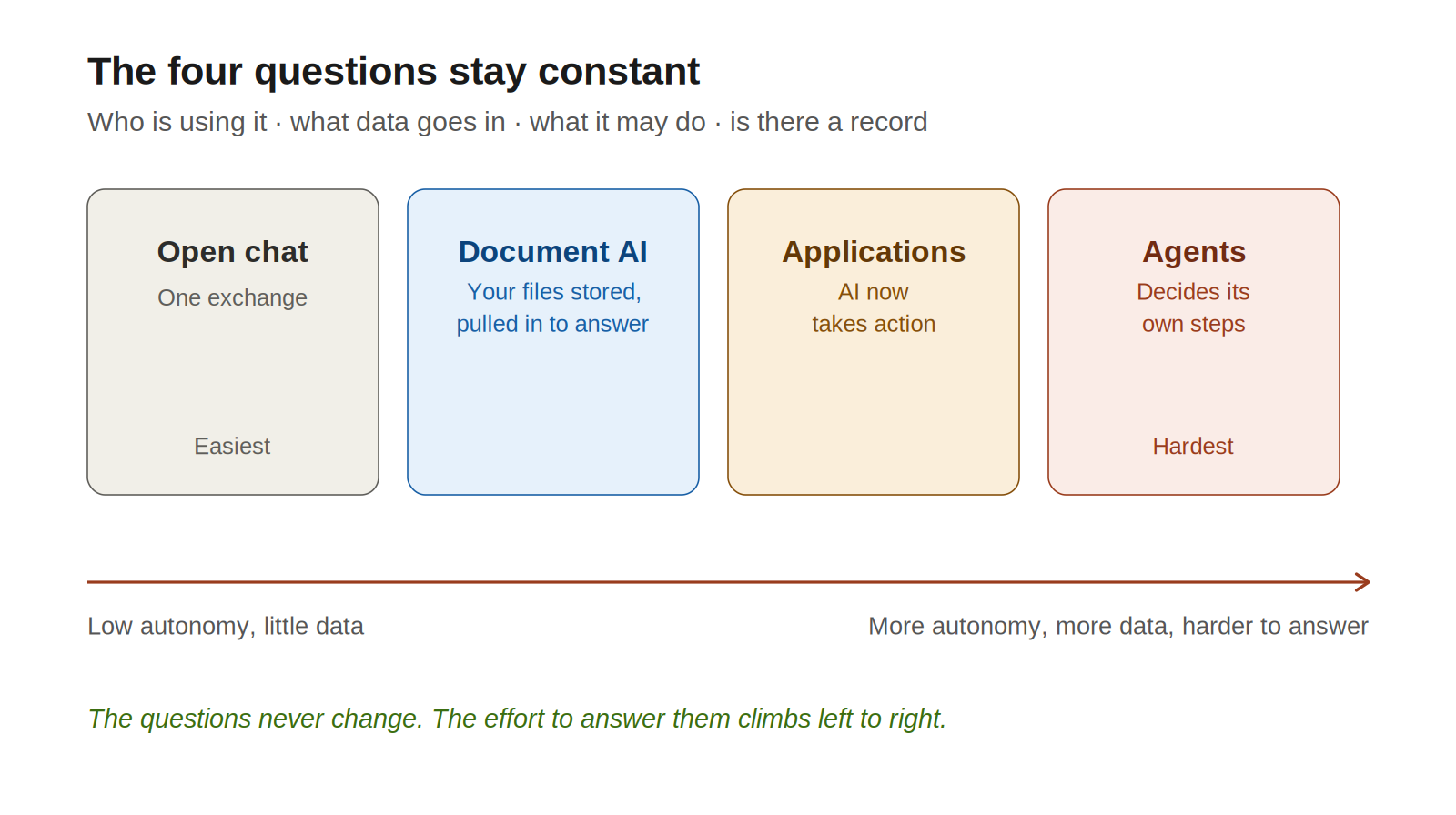
The image above lays it out as a simple line, from the easiest case on the left to the hardest on the right.
At the easy end is plain chat. One person, one question, one answer. Who used it, what they put in, what it did, and a record of it, all trivial to see.
A step harder is document-based AI, the kind that answers questions using your own files. You load documents in, the system indexes them, and later, when someone asks a question, it quietly pulls the relevant passages back out to build the answer. This is often called RAG, for retrieval-augmented generation, but the name matters less than the consequence: the sensitive information reaching the AI isn't just what the person typed, it's whatever the system fetched from your stored files on their behalf. Governing this stage means governing what gets pulled in, not only what gets asked.
Harder again are AI applications that do things, process an invoice, draft a decision, update a record. Now the pressing question becomes "what is it allowed to do," because the AI is acting, not just talking.
And at the hard end are AI agents, which decide their own steps, pull in data as they go, and take several actions in a row toward a goal. Every one of the four questions gets harder at once: who's accountable when the agent acted on its own, what data did it reach for, what was it permitted to do, and can you reconstruct the whole chain afterward.
The pattern is the point. The four questions are always the right ones. What changes is that at the easy end you can get away with hoping for good answers, and at the hard end you need something actually enforcing them. And the whole industry is moving toward the hard end. This is why governance stops being optional precisely as companies adopt the more powerful AI they're most excited about.
You're not the only one noticing this
If all of this feels like it should be more of a recognized discipline by now, it is becoming one. The same four questions, and the five practices around them, are the backbone of the AI standards and frameworks that governments and industry bodies have started publishing. You don't need to study these to run your business, but it helps to know they exist, because they tell you this isn't a passing worry, it's becoming an expectation.
A few worth knowing by name. ISO 42001 is the first international standard for managing AI responsibly inside an organization, essentially a checklist for having the practices above in place and being able to prove it. NIST's AI Risk Management Framework, from the US, is a widely used guide for identifying and managing the risks AI introduces. And the EU AI Act is the first major law regulating AI, with real obligations for higher-risk uses. Different documents, different authors, but read them and the same themes keep surfacing: know how AI is being used, protect sensitive data, keep humans accountable for consequential decisions, and keep records.
The takeaway isn't that you need a compliance project tomorrow. It's that the simple four questions you started this article with are the same ones the standards are built on. Get the basics right and you're not just tidying up an internal worry, you're moving in the direction the whole field is heading.
The mindset that ties it together
Notice what governing AI is not. It's not banning AI, which just pushes usage underground where you can see it even less. And it's not a document that sits in a drawer. It's the practical ability to let your people use AI productively while your organization keeps sight of, and control over, what's happening.
The companies that get this right don't treat AI as a threat to lock down or a free-for-all to ignore. They treat it as something powerful that their people clearly want, and they build a place where that want can be met safely.
Where to start
You don't have to do all five at once. Start by seeing where AI is already used. Then protect your most sensitive information. Then add access controls, human checkpoints, and a record, in that order, as you go. Governance grows with you.
If you'd rather not stitch this together from scratch, this is exactly what we built Forge to do. It gives your teams a private, governed space to use AI on real work: sensitive information protected before it reaches a model, control over who can access what, human approval built into the steps that need it, and a clear record of everything that happened. The five things above, in one place. And it answers those four questions consistently across all of it, whether your teams are chatting, drawing on your own documents, or running AI through a workflow.
If any of this is on your mind, reach out to us and we will show you what it would look like for your business.
Learn more at forgeprivate.com, or contact us.